
The world is changing how it produces, consumes, and values energy. It is not only about climate change or renewables anymore. Factors like energy security, changing demands, financial structures, infrastructure bottlenecks, supply shocks, energy control across geographic borders, and global politics have come into play as we move ahead. The world energy transition scenario currently is reacting to these parameters, and as a result, we are observing a fragmented movement across nations. Domestic energy security and reliability have gained more significance after global turmoil like the recent Middle East war. A stable, affordable domestic energy source has become a geopolitical advantage. A high-volume energy exporter has turned that capacity into a geopolitical weapon. The transition in energy has no single global model. Developed and developing countries have different priorities, and a global-level decision to single-track the trend has and will fail more frequently. As dystopian as it sounds, everyone for themselves is taking a stronghold in the global energy scenario.
Where does Nepal come in this scenario? Is Nepal really downplaying its hand by sitting on top of enormous hydro power potential and doing almost nothing to unlock it? Or has it overestimated the ‘capacity’ aspect and really ignored the infrastructure constraint, execution shortcomings, grid reliability, market size, and structures? Has Nepal mistaken resources for strategy? Its extraordinary hydro potential can only be realized if the power supply can be flexible, reliable, and affordable to the market.
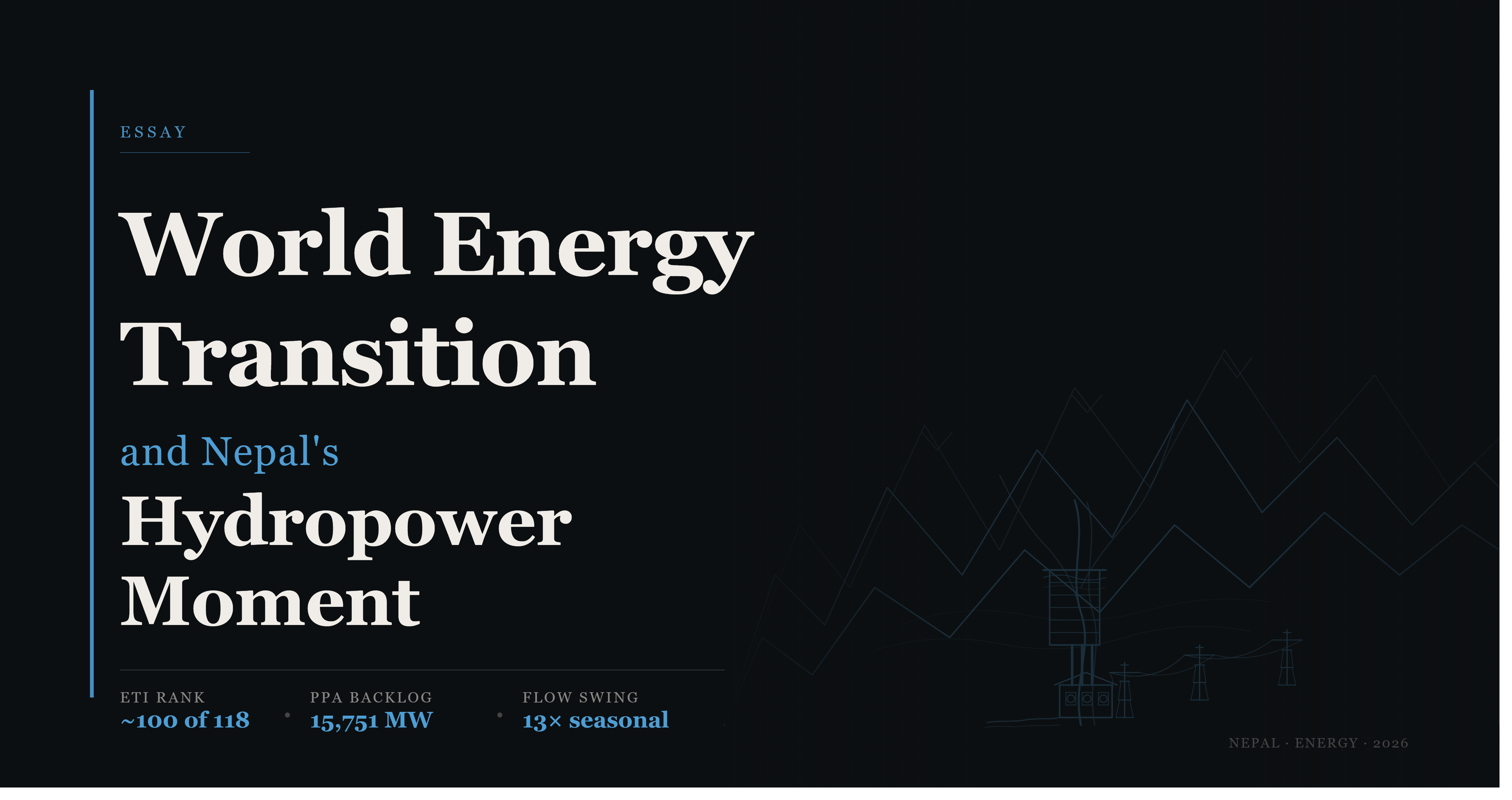
The World Economy Forum’s Energy Transition Index (ETI) is a tool that ranks around 118 countries on two things: how well their current energy system performs, measured across equity (access and affordability), security (reliability of supply), and sustainability (environmental impact) and how ready their broader environment is to support a transition, based on factors like regulation, finance, infrastructure, and innovation. The final score blends both, weighted roughly 60/40 toward current performance over readiness.
In short, it measures whether a country’s energy system works well today and whether it’s structurally positioned to keep improving, not how much raw energy potential or resources a country has. Nepal’s entire case rests on resource potential, which technically means rivers and gradients. But potential is not what this index measures. Resource is not on the index; readiness is. Nepal is ranked the 111th country by this index, which clearly points out the gap in potential and ability to convert that potential into value. Here, value by definition strictly means clean, flexible, reliable, financially profitable, technologically advanced, and adaptable energy for the market.
Nepal’s run-of-river dependence has made power output a hostage to the season. Basically, an overwhelming fleet of Nepal’s electricity-producing power plants is dependent on monsoon-season flows and is too sensitive to the dry and wet seasons. A striking example can be seen in the Trishuli basin, where average flow changes from 50 cubic m/s in the dry season to 650 cubic m/s in the wet season, a 13x swing, which cuts generation to roughly a third of capacity in dry months. This is not just a case of the Trishuli basin but can be observed in almost every runoff river project basin. This scale of energy imbalance always creates an environment of unreliable power output volume to domestic and international markets. When Nepal is celebrating a historic electricity export of 650MW to the international market (India and Bangladesh), the dependency on seasonal flow is so heavy that one severe drought year could flip the country back into being a net importer.
The readiness score in the Energy Transition Index also clearly points out Nepal’s inability to move power domestically and across the border. Transmission of power lags behind generation ambition. This is a critical infrastructural bottleneck that is crippling Nepal’s energy market and preventing it from achieving its full potential. As the monsoon enters, the river flow rises, and plants start producing energy at maximum capacity. But NEA instructs developers to reduce output, to run in contingency, because the transmission line is at capacity. So in reality, ‘take or pay’ is actually ‘take and pay’ in disguise. Under-capacity transmission lines are such a huge hurdle for the Nepali hydro industry.
The most revealing evidence of this bottleneck and of who can actually solve it came from the Marsyangdi Corridor. A 28-kilometer section of the 220 kV Markichok–Bharatpur transmission line, stalled for more than seven years, was completed and commissioned for testing in just a year and a half through active private-sector participation. The line will now carry up to 1,600 MW of power generated in the Marsyangdi basin into the national grid, power that was being produced but had nowhere to go. The government and developers should work together to streamline institutional hurdles, shorten approval timelines, and accelerate environmental clearances. This needs to become policy, not an emergency exception.
On the financial side, Nepal’s slow-moving hydropower sector is being strained by prolonged IPO approvals, currency risk in the international market (especially exposure to the US dollar), and institutional delays that prevent projects from starting and finishing on time. As financial confidence erodes, the industry gradually contracts and eventually stops evolving efficiently. This claim, that Nepal has overestimated capacity and underestimated readiness, is underscored by one number: 264 hydropower projects, totaling over 15,000 MW, already licensed, already invested in, and in many cases partially built, are still waiting for a Power Purchase Agreement. PPAs for run-of-river projects have remained largely blocked since 2018. Most recently, the government introduced a take-and-pay provision in the national budget, meaning NEA would purchase electricity only when it needed it, removing the revenue certainty lenders require. The clause was eventually reversed, but the finance ministry still stopped short of explicitly restoring take-or-pay, leaving the sector in a policy limbo that investors consider worse than an outright refusal. The take-and-pay versus take-or-pay debate has created the kind of uncertainty investors avoid.
And after all this there is an even more complex problem residing, a structural absurdity. Building a hydropower project in Nepal means knocking on 23 separate government doors. Twenty-three bodies, each with its own timeline, its own clearance process, and its own quiet power to say, “Not yet.” They call it a regulatory framework, but it is bureaucratic madness for an industry that is supposed to play a central role in Nepal’s climb toward prosperity.
And still, the targets keep coming. 10,000 MW. Then 15,000 MW. Then 28,500 MW. Now 30,000 MW. Each announcement lands with the confidence of a country that has figured something out. None of them have been accompanied by an honest answer to the question that actually matters: how? Governments change, ministers rotate, the number gets bigger, and the machinery that is supposed to deliver it stays exactly as it was. What happened to the last target is never reviewed. Only the new one is announced. This is what overestimating capacity over readiness looks like, not in a policy paper but in practice. It looks like a country that keeps counting its rivers and forgetting to fix its institutions.
And yet. The opportunity is real.
Nepal’s geographic location for power trade is close to perfect. Almost infinite lengths of flat land for international transmission, power-hungry southern neighbors (India and Bangladesh, as of now), expensive energy per unit on the other side of the border, and heavily reliant on non-renewable energy (which is running out). So the market issue is secondary. Nepal does not need to manufacture demand. It does not need to lobby its neighbors or dress up its product. Cheap, clean, reliable electricity sells itself in a region that is paying more for dirtier alternatives. The market is not the problem. It has never been the problem. The buyer wants firm power, electricity that they can plan around, contract for, and count on regardless of what the monsoon does. The mantra is reliable, non-seasonal, clean, and affordable power. That is ‘premium.’
Now for Nepal to go from today to being a reliable power exporter, it has to bridge the gaps in areas like types of projects, transmission infrastructure, and institutional shifts.
Nepal has to store, not spill. The simple logic behind run-of-river obsession is that it is quick to build, faster, and feasible to finance. But on a broader scale, ROR projects do not produce a product; they produce a commodity. Reservoir and pumped storage hydropower plants that hold water and release it on demand are what convert Nepal from a seasonal seller into a year-round supplier. Policy priority for these kinds of projects is essential. This does not mean to stop ROR projects from building or operating. The only way Nepal can position itself as a reliable year-round exporter is by shifting focus from ROR to storage and acting on it immediately.
Transmission lines, on the other hand, should be considered as a foundation and not an afterthought. For example, the two new 400kV cross-border lines, Inaruwa–Purnea and Lamki–Bareilly, finally got their joint venture agreement signed in October 2025. Target completion: 2030. Five years from signature to transmission, for corridors whose need was obvious long before anyone picked up a pen. For a country sitting on power, it cannot move; that is a long wait. The government needs to buckle up and streamline the construction of this line. A recent development in the Marsyangdi Corridor, as mentioned earlier, has shown that Nepal can build transmission lines fast; it is whether the government will get out of the way fast enough.
At the institutional level, the number of reforms that have to be done is massive. First, treating electricity as a product to sell rather than a state obligation. The producer and the regulator have to accept that electricity has a market price, market signals, and market buyers. Another, single window for all regulation-related works for developers to develop a power plant, and that with a hard deadline. The political will to make this reform is the utmost requirement of these times. The PPA scenario needs to be stabilized. Due to regular freezing and restructuring of the PPA, investors have lost confidence in project development. The reform is not just restoring take-or-pay but committing it legislatively, not just administratively, so that no budget provision or ministerial directive can reverse it overnight.
If Nepal is to build large storage projects, financing only with Nepali banks and investors will never be enough. Nepal needs international financing and investment, and for that, NEA needs to take charge by absorbing exchange rate risk, not for perpetuity like it did with Khimti and Upper Bhotekoshi but for at least the loan repayment time. Financial risk sharing would draw a lot of foreign investors to Nepal.
In the narrative of energy transition in Nepal, it is not about the rivers; it is all about what a country makes out of what it has. Nepal has the rivers and has the gradient; the terrain is pretty much spot-on, and yet, it is ranked as the worst performer. This is the outcome of the disparity between potential and readiness to adapt.
This analysis has a positive note as well; it does not require discovery of anything new for Nepal. It neither requires more rivers, more agreements, or new targets; it just requires completing what it had started, constructing storage-based projects that will provide firm power, laying down the transmission lines before the turbines become operational, fixing the PPA framework so that there is something to rely on for the private investors, and leaving currency risks to be absorbed by the NEA. This is difficult, yet this is feasible; all the blueprints and roadmaps already exist. The gap is entirely in execution.
References
-
Independent Power Producers’ Association Nepal (IPPAN). (2026). Press statement on Marsyangdi Corridor transmission line completion. Kathmandu: IPPAN.
-
Kathmandu Post. (2026, May 18). Government’s 30,000 MW power goal at risk as PPA bottlenecks stall hydropower push. The Kathmandu Post. https://kathmandupost.com
-
Kathmandu Post. (2026, July 1). NEA asks power producers to cut generation as demand fails to keep up with supply. The Kathmandu Post. https://kathmandupost.com
-
Ministry of Energy, Water Resources and Irrigation, Government of Nepal. (2024). Energy Development Roadmap 2081. Kathmandu: Government of Nepal.
-
Nepal Electricity Authority. (2024). Annual report 2023/24. Kathmandu: NEA.
-
Nepal Electricity Authority & Power Grid Corporation of India. (2025, October 29). Joint statement on signing of shareholders’ agreement for Inaruwa–Purnea and Lamki–Bareilly 400kV transmission lines. New Delhi.
-
Nepal Energy Forum. (2013, April 7). NEA to ban Khimti, Bhotekoshi promoters if they do not review PPA. Nepal Energy Forum. http://www.nepalenergyforum.com
-
Nepal Energy Forum. (2015, October 7). Lack of forex risk protection could dissuade hydro investors. Nepal Energy Forum. http://www.nepalenergyforum.com
-
Neupane Legal Associates. (n.d.). Key power project financing challenges in Nepal. https://www.neupanelegal.com
-
Rai, N. (2024). The paradox of Nepal’s hydropower. PEI Center. https://pei.center/wp-content/uploads/2024/08/2.The-Paradox-of-Nepal_s-Hydropower.pdf
-
Shrestha, P., Marasini, R., & Karki, R. (2023). Management of foreign exchange risk for build–own–operate–transfer hydropower projects in Nepal: A good-for-all approach. Journal of Infrastructure Systems, 29(2). https://doi.org/10.1061/JITSE4.ISENG-2149
-
The Himalayan Times. (2018, January 26). NEA to sign PPA in USD with Upper Trishuli-1. The Himalayan Times. https://thehimalayantimes.com
-
World Bank. (2019, April). Nepal energy infrastructure sector assessment. Washington, DC: World Bank Group. https://documents1.worldbank.org/curated/en/592481554093658883/pdf/Nepal-Energy-Infrastructure-Sector-Assessment.pdf
-
World Economic Forum. (2024). Fostering effective energy transition 2024. Geneva: WEF. https://www.weforum.org/publications/fostering-effective-energy-transition-2024
-
World Economic Forum. (2026, June 18). Energy Transition Index 2026. World Economic Forum; Accenture. https://www.weforum.org/publications/energy-transition-index-2026/